MiniMax H3, also released under the name Hailuo 3.0, is MiniMax's flagship AI video model. It generates native 2K footage at 24 frames per second with dialogue, sound effects, and ambience produced in the same pass, in clips of 5 to 15 seconds. MiniMax H3 is available to generate with on PicX Studio today.
What is MiniMax H3 (Hailuo 3.0)?
MiniMax H3 is the third-generation Hailuo video model from MiniMax, following Hailuo 02 and Hailuo 2.3. Its defining traits are native 2K rendering rather than upscaled output, a fixed cinematic 24fps cadence, synchronized audio generation, and a reference budget that spans images, video clips, and audio in a single request. The model also accepts written editing instructions against a finished generation, so an approved clip can be revised without being regenerated from scratch. On PicX Studio the model is selected as MiniMax H3 in the video tools and billed per second of output from pay-as-you-go credits.
MiniMax H3 vs Hailuo 2.3
Hailuo 2.3 produces 1080p clips of roughly ten seconds from a text prompt or a single image, and is well regarded for natural human motion. MiniMax H3 keeps that motion quality and adds native 2K resolution, a 15-second ceiling, multi-shot storytelling inside one generation, omni-reference inputs for character and voice consistency, instruction-based editing, and audio generated alongside the picture. If your project needs a single continuous take longer than ten seconds, or needs sound without a separate design pass, H3 is the newer fit.
Why native 2K matters for delivery
Upscaling recovers pixel count but not detail. Because MiniMax H3 renders at 2K inside the model, fine texture, fabric, hair, and small type survive to the master file rather than being interpolated afterwards. That matters for large-format playback, retail and event screens, and any client brief that names a resolution in the delivery spec. It also removes a step: no separate AI video upscaler run between generation and handover.
Reference-driven character and voice consistency
A single MiniMax H3 generation accepts up to nine reference images, three reference video clips, and three reference audio clips. The model reads them as guidance for identity, styling, motion, and voice rather than treating them as fixed keyframes, which is what lets one character appear in a wide shot, a close-up, and a profile inside the same clip without the face or the voice shifting. Clean references do the heavy lifting here: even lighting, an unobscured direct face angle, and a low-noise voice sample.
MiniMax H3 for advertising and social video
Fifteen seconds with multiple shots covers the standard short-form ad shape — hook, product moment, and end frame — inside one generation, which keeps lighting and product appearance consistent instead of asking an editor to match three separate renders. Vertical 9:16 and square 1:1 ratios cover feed placements, 16:9 and 21:9 cover pre-roll and hero placements, and generated dialogue means a spot can be reviewed with sound from the first pass.
MiniMax H3 for filmmaking and previsualization
At 24fps the output drops into a real edit timeline without conforming or frame blending, which makes MiniMax H3 practical for previs, mood films, and action beats where lighting, atmosphere, camera choreography, and performance all have to agree in one shot. Naming the camera move in professional shot language — a slow orbit, a handheld track, a push in — gives a more predictable camera path than describing the scene alone.
MiniMax H3 pricing on PicX Studio
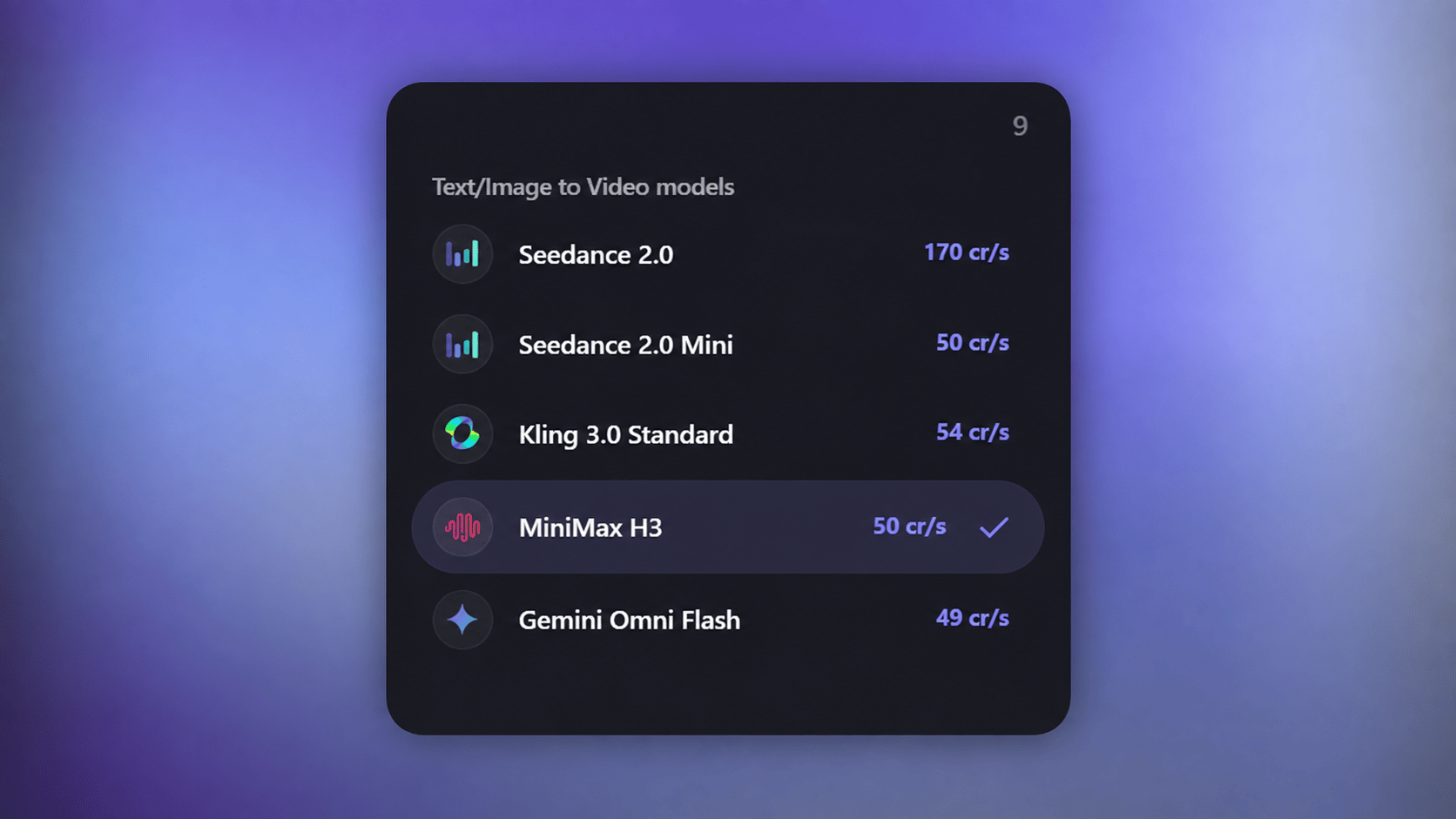
PicX Studio runs on pay-as-you-go credits with no monthly subscription, and new accounts start with free credits. Video is billed per second of output, so a five-second clip costs a fraction of a fifteen-second one. Because MiniMax H3 only outputs 2K, its per-second rate is flat rather than tiered by resolution. Current rates for MiniMax H3 and every other video model sit on the credits page.
MiniMax H3 is live on PicX Studio — pay only for the seconds you render.See credits ›
Video generation model
MiniMax H3 — Video Generation Model
Also known as Hailuo 3.0, MiniMax H3 renders native 2K video with dialogue and sound generated in the same pass, up to 15 seconds per clip. Combine image, video, and audio references to hold a character, a style, and a voice across every shot.

Community
Community Creations
A look at what MiniMax H3 produces across character work, motion studies, and multi-shot scenes. Hover any clip to preview it, or tap to watch with sound.
Key features
Key Features of MiniMax H3 (Hailuo 3.0)
Generate crisp, native 2K video
MiniMax H3 renders at full 2K pixel density inside the model itself, so crisp detail is the output rather than the result of a separate enhancement pass. That matters when your video has to hold up on a large display, a retail screen, or a client's high-resolution delivery spec.
Try nowGet true cinematic motion
MiniMax H3 generates at a fixed 24 frames per second, the same cadence film and broadcasts are shot at, so your clip cuts into a real timeline without conforming or frame blending. Stronger temporal consistency keeps motion stable across the whole take instead of warping or drifting partway through.
Try nowKeep one character consistent
MiniMax H3 accepts up to 12 reference files in a single generation, in any mix of images, video clips, and audio clips, and holds a character's face, styling, motion, and voice across every shot. Pair it with a saved character reference to keep the same person through a full sequence.
Try nowGet fully synced audio
MiniMax H3 produces dialogue, sound effects, and room atmosphere alongside the video in one pass, timed to what happens on screen. Speech lands on the mouth movements and glass cracks as it breaks, so you skip the separate sound design step for short-form work.
Try nowEdit videos by chatting
MiniMax H3 takes editing instructions on an existing generation and applies them to characters, objects, scenes, sound, or pacing. Change a jacket color, swap the background, or retime the action by describing the change in words, all within the same AI video generator.
Try nowGet fully synced audio
MiniMax H3 produces dialogue, sound effects, and room atmosphere alongside the video in one pass, timed to what happens on screen. Speech lands on the mouth movements and glass cracks as it breaks, so you skip the separate sound design step for short-form work.
Try nowHow it works
How to Use MiniMax H3 (Hailuo 3.0) on PicX Studio
Three steps take you from a blank prompt to your first clip.
 Step 01
Choose your model
Open the PicX Studio video tools and pick MiniMax H3 from the model menu.
 Step 02
Prompt and add references
Describe the subject, action, camera move, and lighting, spell out the dialogue and sounds you want, then attach any image, video, or audio references.
 Step 03
Generate and export
Set duration and aspect ratio, generate, then review the clip with sound on and download it.
Use cases
Built for Longer and Sharper Video
Longer ad creatives
A complete spot needs an opening, a product moment, and a closing frame. At 15 seconds with several shots in one generation, lighting and product appearance stay consistent from first frame to last, so you review one clip instead of matching three.
Try it NowAction scenes and filmmaking
Lighting, atmosphere, camera choreography, and performance all have to agree before a shot reads as film rather than as a clip. H3 resolves those in a single pass at 24fps, which suits previs, mood films, and action beats.
Try it NowCharacter-driven storytelling
A short film needs the same person in a wide, a close-up, and a profile without the face or the voice changing. H3 holds identity from your reference assets and generates multiple shots per clip, so a full scene fits in one go.
Try it NowCommercial content production
Product listings, brand social, game trailers, and interface motion all expect a clean high-resolution master. Native 2K delivers that without an upscaling step, and H3 handles text overlays, brand elements, and product showcases.
Try it NowPrompting
Tips for Best Results

Name your camera move in the prompt
Write the move out in shot language — "slow orbit to the right", "handheld tracking shot". The model follows camera terminology while it generates, so naming the move gives a steadier camera path than describing the scene alone.

Refine with an edit instruction
When a generation is close but one detail is off, send an edit instruction instead of starting a fresh prompt. Editing keeps the framing, lighting, and performance you already approved and changes only the part you named.

Upload a clean reference for character work
For a recurring person, use reference images with even lighting, a direct face angle, and nothing covering the features, plus a clean audio clip for the voice. Consistency comes from that data, so a profile shot or a noisy recording gives the model less to hold onto.
Specifications
MiniMax H3 at a Glance
What the model outputs and what it accepts, so you know before you spend a credit.
- Resolution
- Native 2K (the only output tier MiniMax H3 supports)
- Frame rate
- 24 FPS, fixed
- Duration
- 5 to 15 seconds per generation
- Aspect ratios
- 21:9, 16:9, 4:3, 1:1, 3:4, 9:16, or adaptive
- Inputs
- Text, first or last keyframe image, or reference assets
- Reference budget
- Up to 12 files total, mixing images, video clips, and audio clips
- Audio
- Dialogue, effects, and ambience generated in the same pass
- Editing
- Instruction-based edits on a finished generation
More on PicX Studio
Other Models
Every model on PicX Studio — video, image, audio, and agents — running on the same pay-as-you-go credits, with no subscription.










FAQ
Frequently Asked Questions
What is MiniMax H3 or Hailuo 3.0?
MiniMax H3, also called Hailuo 3.0, is the flagship video model from MiniMax, the lab behind Hailuo 02 and Hailuo 2.3. It generates native 2K at 24fps, clips from 5 to 15 seconds, text-to-video and image-to-video, reference support for image, video, and audio inputs, multi-shot storytelling, instruction-based editing, and synchronized audio.
What inputs does MiniMax H3 accept?
It works from a text prompt alone, from a first or last keyframe image, or from reference assets. You can supply up to 12 reference files in one generation, in any mix of images, video clips, and audio clips — for example 8 images, 2 videos, and 2 audio clips. Each reference clip runs 2 to 15 seconds, with at most 15 seconds of video and 15 seconds of audio in total, and audio needs at least one image or video alongside it. The model uses them for style, character, motion, or voice guidance without forcing them as keyframes.
Does MiniMax H3 generate audio?
Yes. Dialogue, sound effects, and environmental ambience are generated alongside the video in the same pass and timed to the on-screen action, which removes the separate audio step for most short-form projects.
What is the difference between MiniMax H3 and Hailuo 2.3?
Hailuo 2.3 generates 1080p clips up to roughly 10 seconds from a text prompt or a single image. MiniMax H3 moves to native 2K with clips up to 15 seconds, and adds reference inputs, instruction-based editing, multi-shot storytelling, and synchronized audio on top of the human motion quality Hailuo 2.3 already had.
Can I edit a video after generating it?
Yes. MiniMax H3 supports instruction-based editing, so you can adjust characters, objects, scenes, sound, and pacing on a finished generation by describing the change in words. That lets you iterate on an approved clip instead of regenerating it from the prompt.
What resolutions and aspect ratios does Hailuo 3.0 support?
MiniMax H3 outputs native 2K at 24fps — 2K is the resolution tier PicX Studio offers for this model. You can choose 21:9, 16:9, 4:3, 1:1, 3:4, or 9:16, or leave the ratio adaptive and let the model pick framing that suits your prompt.
How much does MiniMax H3 cost on PicX Studio?
PicX Studio bills pay-as-you-go credits with no subscription, and video is charged per second of output, so a 5-second clip costs a fraction of a 15-second one. The MiniMax H3 rate is flat per second because the model only outputs 2K. New accounts start with free credits — current rates are on the credits page.