How do I use the The Barista Rube Goldberg Machine template?
Edit the prompt in the box under the preview — the template's model and format are already selected — and press Generate. Your version appears right on this page.
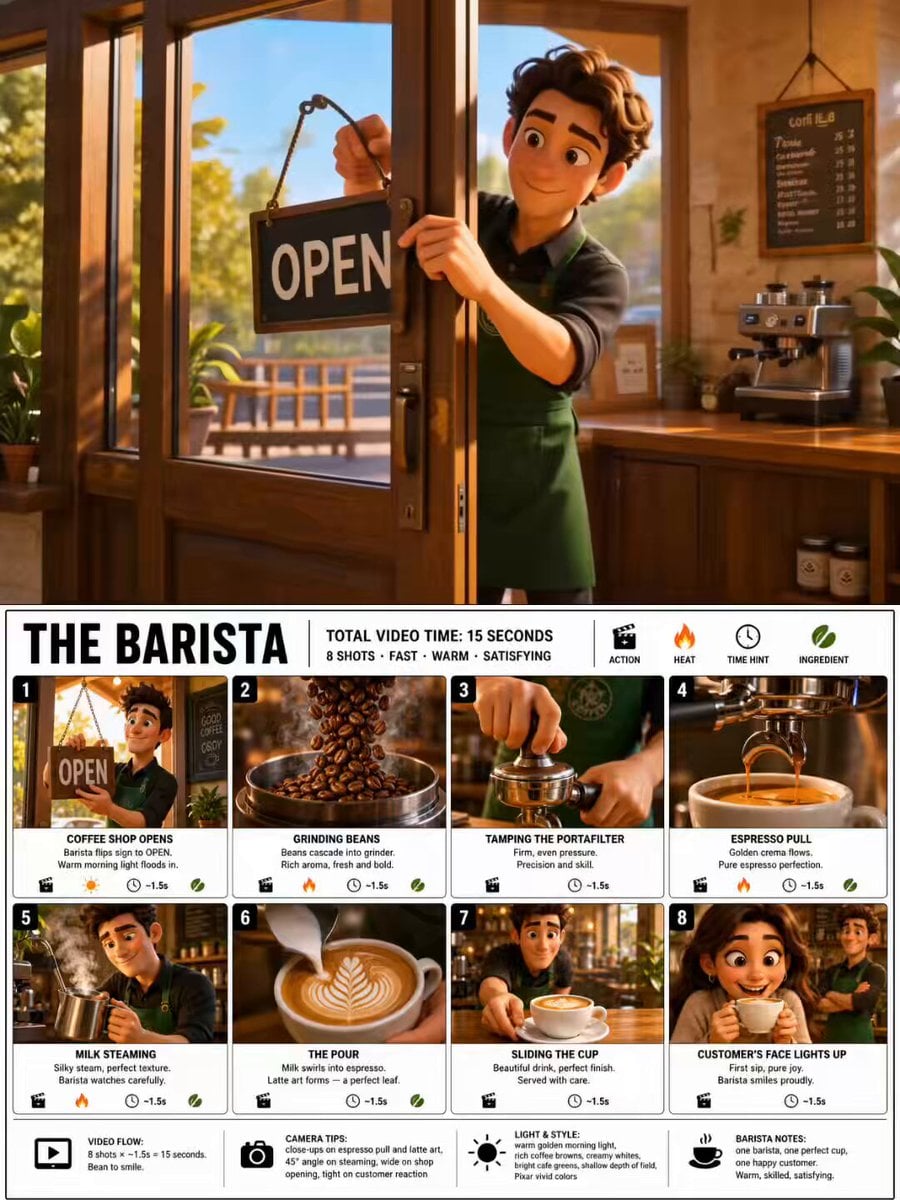
An extremely detailed, multi-section prompt for a 15-second video sequence featuring a frantic barista whose café is an interconnected Rube Goldberg machine.
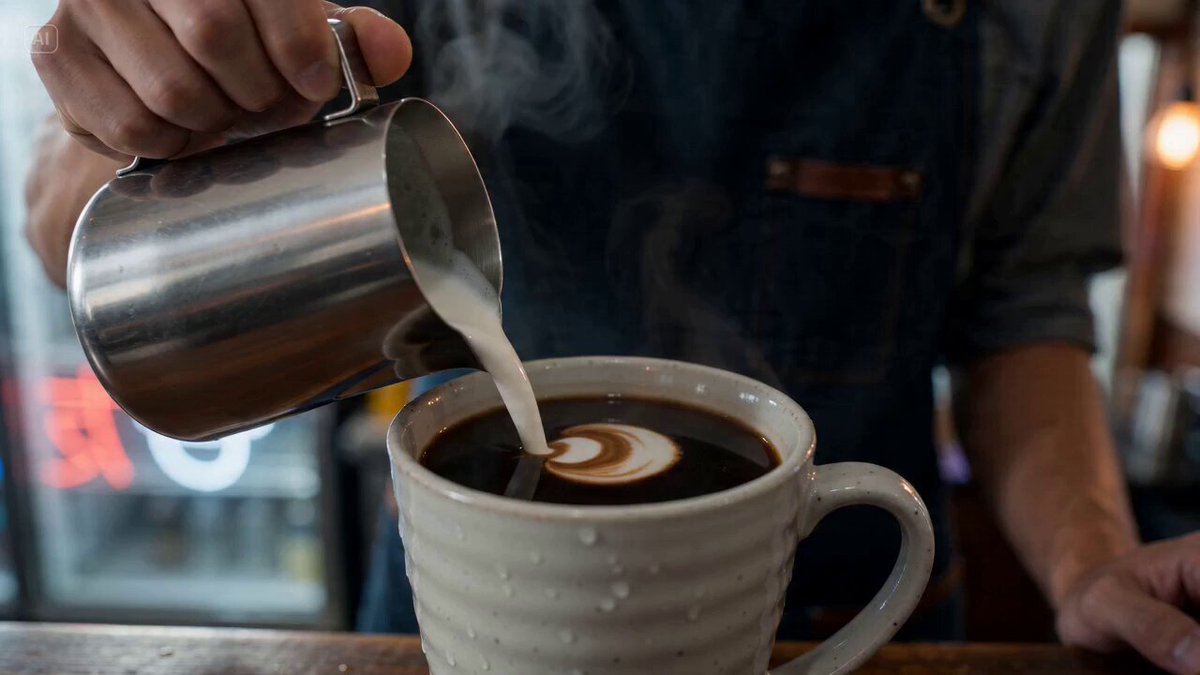
SUBJECTS: Subject 1: A frantic barista — small, wiry, early 30s with permanently startled eyes and perpetual five o'clock shadow. Wild curly black hair barely contained under a brown newsboy cap. Wears a wrinkled olive-green apron over a flannel shirt with haphazardly rolled sleeves. Moves like a pinball — bouncing between stations, sliding across the floor, catching things mid-air without looking. Every movement triggers the next part of the machine. His body IS part of the mechanism. Pixar-style 3D rendering: rubbery expressive limbs, exaggerated squash-and-stretch on fast movements, warm skin tones. Subject 2: The café itself — every object is a component of one interconnected Rube Goldberg machine. The espresso machine is the central engine. The sequence involves: a marble track built from bent spoons along the ceiling, balanced cups on saucers that tip like dominoes, a hanging mobile of sugar cubes acting as a counterweight system, a toy train on a track delivering milk from the fridge to the steamer, and a small catapult made from a ruler and napkin holder that launches the finished cup to the counter. Subject 3: The customer — a deadpan woman in a business suit, briefcase in hand, reading glasses on a chain. Completely unfazed by the chaos. She stands at the counter with the patience of someone who has seen this before. ENVIRONMENT: A tiny corner café — barely ten feet wide. Exposed brick walls covered in chalkboard menus with hand-drawn coffee illustrations. Every horizontal surface has a mechanical element: marble tracks on shelves, cup-and-saucer balance chains along the counter, tiny pulleys strung from the ceiling with twine. Warm morning light streams through a single front window catching dust and steam. A small bell hangs above the door. The whole space feels like a brilliant inventor's workshop that serves coffee. MOOD: Manic joy. The barista is in his element — the chaos is intentional, practiced, musical. Every crash, pour, and launch is precisely timed. The punchline deflates the entire spectacle in the best possible way. TIMELINE: 0:00–0:03: The door opens — bell dings. The customer places her briefcase on the counter. Says nothing. The barista points at her, nods — he knows the order. He flicks a marble from his apron pocket onto a ceiling track. The marble rolls — clicking over ridges, banking around a curve, dropping through a funnel into a cup on a saucer on a high shelf. The cup's weight tips the saucer, pulls a string, releases a cabinet latch — coffee beans slide down a ramp into a hand-crank grinder. Audible: bell ding, marble clicking on track, cup clinking, string twang, beans cascading. 0:03–0:06: The barista cranks the grinder with one hand while pulling a lever starting the toy train. The train chugs along a counter-edge track — passes the fridge where a small arm places a milk carton in the car — continues to the steam wand where the track tilts and pours milk into a steaming pitcher. Ground coffee falls through a chute into the portafilter. The barista slams it in with his elbow while catching a falling sugar cube from the overhead mobile with his other hand, dropping it into a cup. Audible: grinder crunching, train chugging and whistling, milk pouring, portafilter clicking, mobile tinkling. 0:06–0:09: Espresso machine fires — rich dark coffee flowing into a porcelain cup. Close-up: crema forming, thick and golden-red, swirling. The barista steams milk — pitcher vibrating, velvety microfoam building. He pours with a practiced wrist flick — a perfect rosetta latte art pattern forms. He tops it with a single coffee bean placed dead center. Camera lingers on the completed drink — perfect, beautiful. Audible: espresso hissing, milk steaming (tearing-paper sound), the gentle pour, the bean placed with a tiny tap. 0:09–0:12: The delivery. The barista places the cup on the ruler catapult and slams his palm down. The cup launches in a perfect arc — camera follows in slow motion as it rotates, latte art intact, not a drop spilled. It lands with a clean clink on a saucer directly before the customer. Steam rises in a perfect spiral. The barista slides into frame behind the counter, slightly breathless, fingers pointing at the drink with showman's pride. Audible: catapult snap, cup whistling through air, clean landing clink, a beat of silence. 0:12–0:15: The customer adjusts her reading glasses. Looks at the latte art. Looks at the barista. "Actually — can I get tea?" The barista's face falls — completely deflated. Shoulders drop. Cap slides askew. A long beat. Then his eyes snap back to life. He pulls out a different marble — a green one — and flicks it onto a completely different track on the opposite wall. The entire café begins moving again — a whole new sequence activating. The customer takes a seat. She's done this before. Cut to black. Audible: her flat delivery, the defeated exhale, then the green marble clicking onto the track and the café machine roaring back to life.
SUBJECTS: Subject 1: A frantic barista — small, wiry, early 30s with permanently startled eyes and perpetual five o'clock shadow. Wild curly black hair barely contained under a brown newsboy cap. Wears a wrinkled olive-green apron over a flannel shirt with haphazardly rolled sleeves. Moves like a pinball — bouncing between stations, sliding across the floor, catching things mid-air without looking. Every movement triggers the next part of the machine. His body IS part of the mechanism. Pixar-style 3D rendering: rubbery expressive limbs, exaggerated squash-and-stretch on fast movements, warm skin tones. Subject 2: The café itself — every object is a component of one interconnected Rube Goldberg machine. The espresso machine is the central engine. The sequence involves: a marble track built from bent spoons along the ceiling, balanced cups on saucers that tip like dominoes, a hanging mobile of sugar cubes acting as a counterweight system, a toy train on a track delivering milk from the fridge to the steamer, and a small catapult made from a ruler and napkin holder that launches the finished cup to the counter. Subject 3: The customer — a deadpan woman in a business suit, briefcase in hand, reading glasses on a chain. Completely unfazed by the chaos. She stands at the counter with the patience of someone who has seen this before. ENVIRONMENT: A tiny corner café — barely ten feet wide. Exposed brick walls covered in chalkboard menus with hand-drawn coffee illustrations. Every horizontal surface has a mechanical element: marble tracks on shelves, cup-and-saucer balance chains along the counter, tiny pulleys strung from the ceiling with twine. Warm morning light streams through a single front window catching dust and steam. A small bell hangs above the door. The whole space feels like a brilliant inventor's workshop that serves coffee. MOOD: Manic joy. The barista is in his element — the chaos is intentional, practiced, musical. Every crash, pour, and launch is precisely timed. The punchline deflates the entire spectacle in the best possible way. TIMELINE: 0:00–0:03: The door opens — bell dings. The customer places her briefcase on the counter. Says nothing. The barista points at her, nods — he knows the order. He flicks a marble from his apron pocket onto a ceiling track. The marble rolls — clicking over ridges, banking around a curve, dropping through a funnel into a cup on a saucer on a high shelf. The cup's weight tips the saucer, pulls a string, releases a cabinet latch — coffee beans slide down a ramp into a hand-crank grinder. Audible: bell ding, marble clicking on track, cup clinking, string twang, beans cascading. 0:03–0:06: The barista cranks the grinder with one hand while pulling a lever starting the toy train. The train chugs along a counter-edge track — passes the fridge where a small arm places a milk carton in the car — continues to the steam wand where the track tilts and pours milk into a steaming pitcher. Ground coffee falls through a chute into the portafilter. The barista slams it in with his elbow while catching a falling sugar cube from the overhead mobile with his other hand, dropping it into a cup. Audible: grinder crunching, train chugging and whistling, milk pouring, portafilter clicking, mobile tinkling. 0:06–0:09: Espresso machine fires — rich dark coffee flowing into a porcelain cup. Close-up: crema forming, thick and golden-red, swirling. The barista steams milk — pitcher vibrating, velvety microfoam building. He pours with a practiced wrist flick — a perfect rosetta latte art pattern forms. He tops it with a single coffee bean placed dead center. Camera lingers on the completed drink — perfect, beautiful. Audible: espresso hissing, milk steaming (tearing-paper sound), the gentle pour, the bean placed with a tiny tap. 0:09–0:12: The delivery. The barista places the cup on the ruler catapult and slams his palm down. The cup launches in a perfect arc — camera follows in slow motion as it rotates, latte art intact, not a drop spilled. It lands with a clean clink on a saucer directly before the customer. Steam rises in a perfect spiral. The barista slides into frame behind the counter, slightly breathless, fingers pointing at the drink with showman's pride. Audible: catapult snap, cup whistling through air, clean landing clink, a beat of silence. 0:12–0:15: The customer adjusts her reading glasses. Looks at the latte art. Looks at the barista. "Actually — can I get tea?" The barista's face falls — completely deflated. Shoulders drop. Cap slides askew. A long beat. Then his eyes snap back to life. He pulls out a different marble — a green one — and flicks it onto a completely different track on the opposite wall. The entire café begins moving again — a whole new sequence activating. The customer takes a seat. She's done this before. Cut to black. Audible: her flat delivery, the defeated exhale, then the green marble clicking onto the track and the café machine roaring back to life.
Edit the prompt in the box under the preview — the template's model and format are already selected — and press Generate. Your version appears right on this page.
Yes. You can change the subject, setting, lighting, mood, format, and available model controls before creating your video.
Opening and editing this template is free. Generating uses credits, shown on the Generate button when you are signed in.
Start with Seedance 2.0, which is the model associated with this template. You can compare another compatible model for a different finish.
Follow a topic to a crawlable collection of related PicX Studio templates.