How do I use the Fictional World Map Attempts Collage template?
Choose the primary action to open PicX Studio with the available template settings. Review the model and format, personalize the creative direction, and generate when ready.
Generates a zoomed-out contact sheet of many failed futuristic fictional world map variations for creative worldbuilding. Change the subject, setting, or lighting one variable at a time.
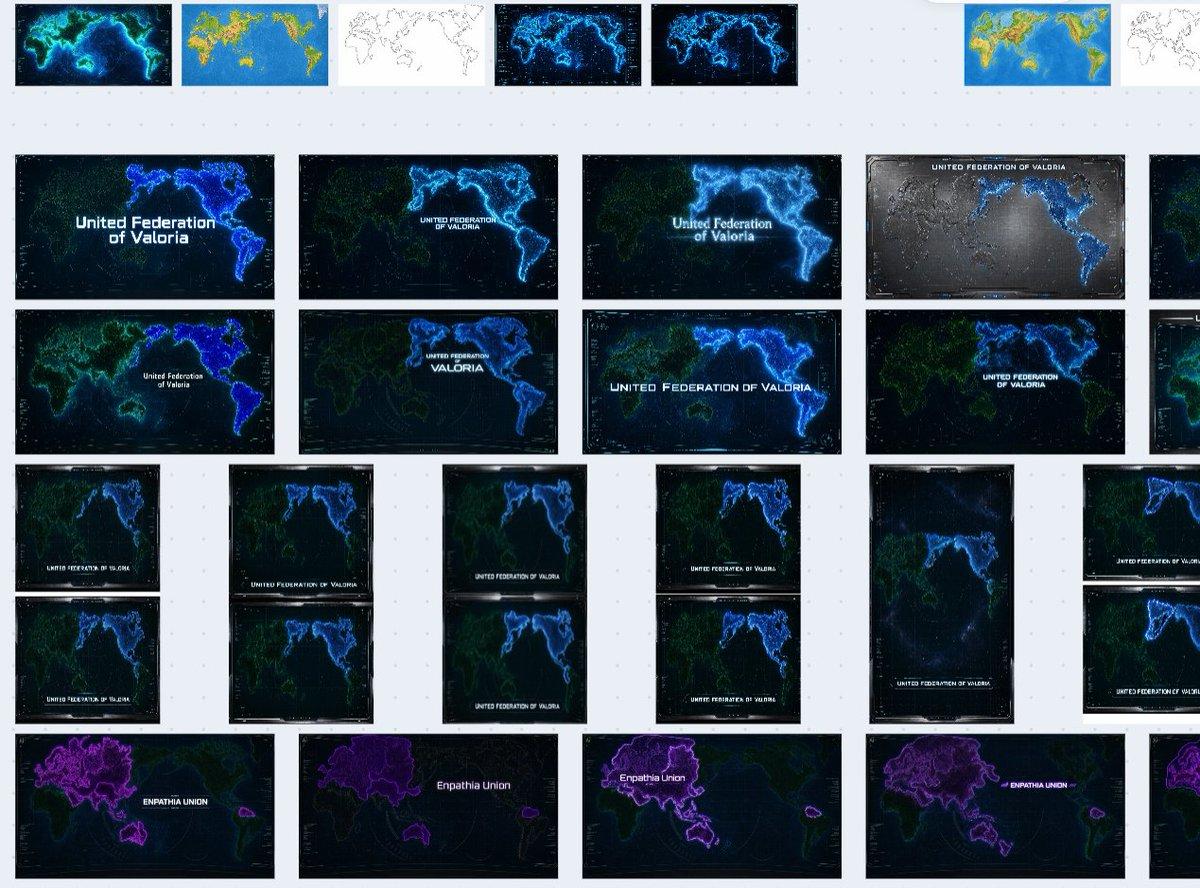
Goal: Create a screenshot-like collage showing a pile of unusable AI-generated fictional world map attempts on a pale gray workspace, as if viewed on an image-generation history board. The subject is not one map, but a messy contact sheet of many map thumbnails for a future fictional nation. Canvas: Wide 16:10 landscape canvas, light gray background with a faint dotted grid pattern. Leave generous gutters between thumbnails. The entire composition should feel like a zoomed-out browser or design-board view, with some thumbnails cut off by the right edge. Layout: Arrange exactly 35 visible map thumbnails in an irregular grid. Count them as: 8 small thumbnails across the top row, 10 large landscape thumbnails in the middle two rows, 12 smaller portrait/landscape thumbnails in the lower middle arranged in paired columns, and 5 large purple-themed thumbnails along the bottom row. Include several partially cropped thumbnails on the far right edge to imply the board continues off-screen. Thumbnail content: Each thumbnail is a different failed variation of a futuristic world map for {argument name="fictional nation name" default="United Federation of Valoria"}. Most maps show altered Earth-like continents but not an accurate real-world map. Use dark navy or black ocean backgrounds, neon blue coastlines, cyan glowing borders, faint green landmasses, satellite-map textures, grid overlays, small HUD-like ticks, and occasional white title text. Some thumbnails should look like color tests: one bright blue-and-yellow terrain map, one simple black-outline map on white, and multiple glowing cyberpunk versions. The bottom row should use a different purple faction label, {argument name="bottom faction name" default="Empathia Union"}, with purple-highlighted landmasses around Eurasia/Australia-like shapes. Visible labels: Repeat the title text on many thumbnails, usually centered or near the lower third, reading {argument name="main map label" default="United Federation of Valoria"}. Vary the typography and size slightly so some labels are tiny, misaligned, or awkwardly placed. Bottom-row thumbnails should instead read {argument name="purple map label" default="Empathia Union"}. A few labels may be partially illegible due to scale, cropping, or glow. Visual style: Make it look like a collection of generated image results, not a polished infographic. Use inconsistent map compositions, inconsistent coastline shapes, different zoom levels, different title placements, and slightly mismatched aspect ratios. The dominant palette is black, deep navy, electric cyan, blue, green, and purple, with occasional white thumbnails and one or two bright terrain-map thumbnails. Constraints: Do not create a single clean world map. Do not make the continents match the real Earth exactly. Do not add people, UI controls, large captions, watermarks, or a polished final design. Preserve the feeling of many discarded attempts scattered on a pale dotted canvas.
Choose the primary action to open PicX Studio with the available template settings. Review the model and format, personalize the creative direction, and generate when ready.
Yes. You can change the subject, setting, lighting, mood, format, and available model controls before creating your image.
This template is free to open and customize. Generation usage is shown in PicX Studio before you create.
Start with GPT Image 2, which is the model associated with this template. You can compare another compatible model for a different finish.
© 2026 PicX Studio. All rights reserved.

Follow a topic to a crawlable collection of related PicX Studio templates.
43,474 public templates available. Verified via the PicX Studio public templates API; refreshed hourly.





![3D Fantasy World Map Infographic — A hyper-realistic 3D world guide infographic poster for [SHOW]. The fictional world of [SHOW] is rendered as a raised, textur](/_next/image?url=https%3A%2F%2Fcdn.picxstudio.com%2Fuploads%2Fmeigen_2045107949639455223_17269cbc-41e4-46a4-be16-ab44b3c70b61.jpg&w=828&q=100)









![Minimalist Flat Vector Travel Poster — Premium minimalist flat-vector travel poster for {argument name="city name" default="[CITY_NAME]"}, 3:4 vertical format.](https://cms-assets.youmind.com/media/1787917359711_3ug846_HQX205cbMAA6F6S-300x400.jpg)

























![Scientific Ultra-Macro Insect Capture Prompt — "[GOAL] Hyper-realistic ultra-macro insect capture in mid-air
[SUBJECT] predatory wasp carrying a bright green ca](https://pbs.twimg.com/media/G7nwHTXbsAAASSE.jpg)





![Cutout Pop Product Photography Prompt — {argument name="product" default="[PRODUCT]"} suspended in front of a die-cut shape ({argument name="shape" default="cir](https://pbs.twimg.com/media/G9p17ttbwAAOwd-.jpg)