Japanese Corridor Vocabulary Poster
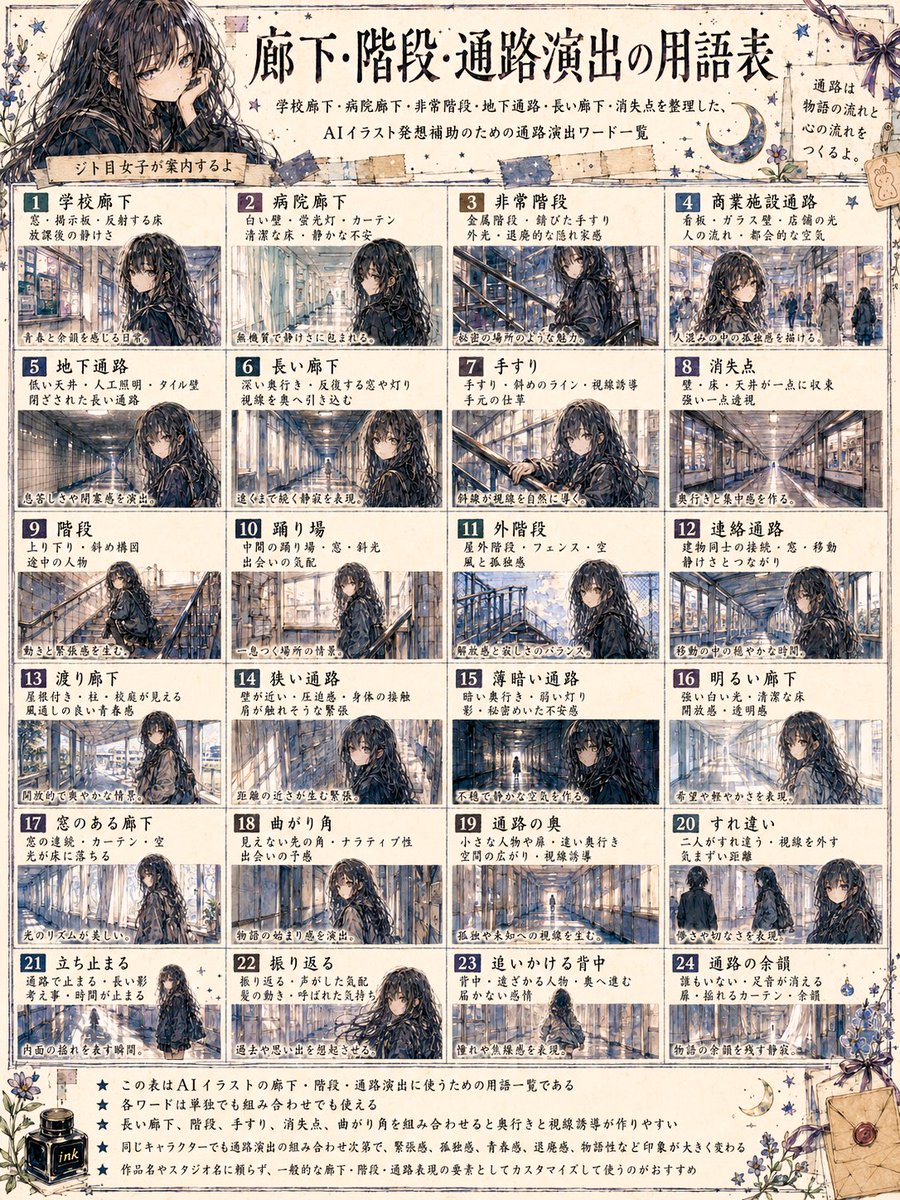
Goal: Create a dense Japanese reference poster/infographic titled {argument name="headline text" default="廊下・階段・通路演出の用語表"}, a vocabulary chart for illustrating hallways, stairs, and passageway scenes. Make it look like a hand-drawn scrapbook study sheet for AI illustration prompt words, with many miniature scene examples featuring the same mysterious gothic schoolgirl guide.
Canvas: Vertical 4:5 poster, warm ivory aged paper background with visible paper grain, thin ruled grid lines, taped corners, tiny stars, moons, flowers, stationery doodles, ink bottle, envelope, ribbon, and washi tape decorations around the border. Overall palette is sepia beige, muted navy, smoky gray, faded blue, and black ink. Use an analog watercolor, pencil, and ink style with slightly messy handwritten Japanese typography.
Main character: A recurring {argument name="character description" default="gloomy Jitome girl with long messy black hair, dark school uniform, pale skin, sleepy eyes, and a melancholic expression"}. She appears once large at the upper left as the guide and repeatedly inside the example thumbnails. The large portrait has a small label reading 「ジト目女子が案内するよ」. Keep the character’s face visible and consistent where she appears, with wet-looking hair strands and gothic, moody styling.
Header layout: At the top center place the large title 「廊下・階段・通路演出の用語表」. Beneath it add a subtitle line like 「学校廊下・病院廊下・非常階段・地下通路・長い廊下・消失点を整理した、AIイラスト発想補助のための通路演出ワード一覧。」 On the upper right add a decorative note card with a crescent moon and the text 「通路は物語の流れと心の流れをつくるよ。」
Central layout: Use exactly 24 numbered rectangular cards in a 4-column by 6-row grid. Each card must have a colored number tab, a Japanese category title, a few tiny handwritten keyword lines, and a small watercolor scene thumbnail. The thumbnails should show corridors, stairs, passageways, windows, vanishing points, reflections, silhouettes, or the gothic girl in different positions. Count and include these 24 cards exactly:
1. 「学校廊下」 — school hallway with lockers, bulletin boards, afternoon light.
2. 「病院廊下」 — quiet hospital corridor with white walls, curtains, clean unease.
3. 「非常階段」 — emergency stairwell, metal rails, cold light, escape-route tension.
4. 「商業施設通路」 — shopping mall passage with people flow and urban brightness.
5. 「地下通路」 — low ceiling, artificial lighting, tiled walls, damp heaviness.
6. 「長い廊下」 — deep vanishing point, repeating windows and doors.
7. 「手すり」 — railing lines guiding the eye along stairs or corridor.
8. 「消失点」 — one-point perspective corridor converging into distance.
9. 「階段」 — up/down movement, diagonal composition, a person midway.
10. 「踊り場」 — stair landing, pause between floors, quiet turning point.
11. 「外階段」 — outdoor stairs with fence, sky, wind, exposed metal.
12. 「連絡通路」 — connecting passage between buildings, movement and transition.
13. 「渡り廊下」 — covered school walkway with view outside and nostalgia.
14. 「狭い通路」 — narrow passage, close walls, body brushing through.
15. 「薄暗い通路」 — dark corridor, weak light, humid uneasy atmosphere.
16. 「明るい廊下」 — open bright hallway, clean floor, hopeful transparent light.
17. 「窓のある廊下」 — windows, curtains, light and shadow bands.
18. 「曲がり角」 — corner turn, unseen continuation, narrative suspense.
19. 「通路の奥」 — far end of corridor, small figure, depth and destination.
20. 「すれ違い」 — two characters passing each other without eye contact.
21. 「立ち止まる」 — character stopped in passage, back view, quiet hesitation.
22. 「振り返る」 — character looking back over shoulder, hair and skirt movement.
23. 「追いかける背中」 — chasing or following someone’s back in a passage.
24. 「通路の余韻」 — empty corridor after people leave, lingering atmosphere.
Bottom section: Add a handwritten notes area with star bullet points explaining that this is a word list for school corridors, hospitals, stairs, and passage演出, useful for combining with keywords like long hallway, staircase, railing, vanishing point, curve, light, shadow, silhouettes, and passing-by scenes. Keep the text dense but legible, like a Japanese prompt-word cheat sheet.
Visual style: Delicate anime watercolor illustration, sketchbook infographic, hand-lettered Japanese, thin ink outlines, soft blue-gray shadows, warm parchment paper, collage tape, decorative celestial motifs. The poster should feel information-dense, cozy, nostalgic, slightly gothic, and handmade.
Constraints: Use exactly 24 numbered cards in the grid; keep the large title readable; avoid modern flat vector style; no photorealism; no English labels except decorative tiny marks if needed; no watermark or logo.




![Scientific Ultra-Macro Insect Capture Prompt — "[GOAL] Hyper-realistic ultra-macro insect capture in mid-air
[SUBJECT] predatory wasp carrying a bright green ca](https://pbs.twimg.com/media/G7nwHTXbsAAASSE.jpg)





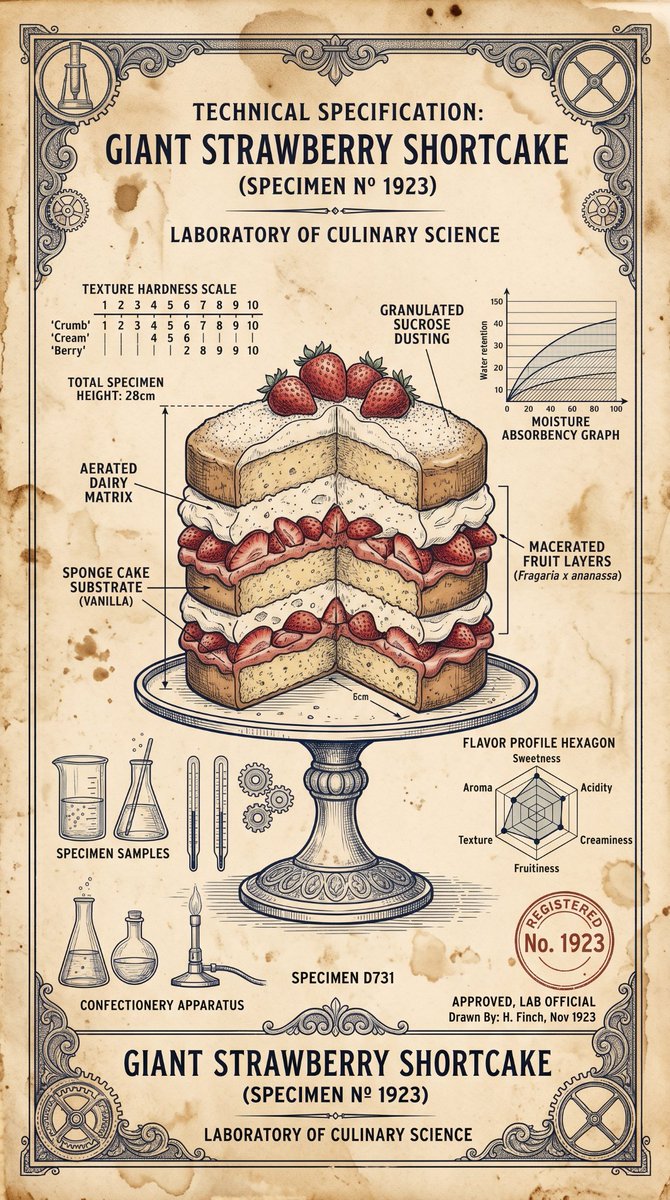
![Scientific Dessert Blueprint — A vintage, technical scientific diagram of [{argument name="subject" default="A GIANT STRAWBERRY SHORTCAKE"}], styled as a {argum](https://pbs.twimg.com/media/HH7bLyCbMAAOvY6.jpg)


![Naive doodle-style subject illustration — A doodle-style {argument name="subject" default="[subject]"}, naive lines, humorous shape exaggeration](https://pbs.twimg.com/media/G6Wl2YxbsAARB2b.jpg)