How do I use the Executive AI Operating Readout template?
Choose the primary action to open PicX Studio with the available template settings. Review the model and format, personalize the creative direction, and generate when ready.
A square sketchnote-style executive infographic summarizing a personal AI operating identity, bottlenecks, future advantage, and ideal AI team setup. Change the subject, setting, or lighting one variable at a time.
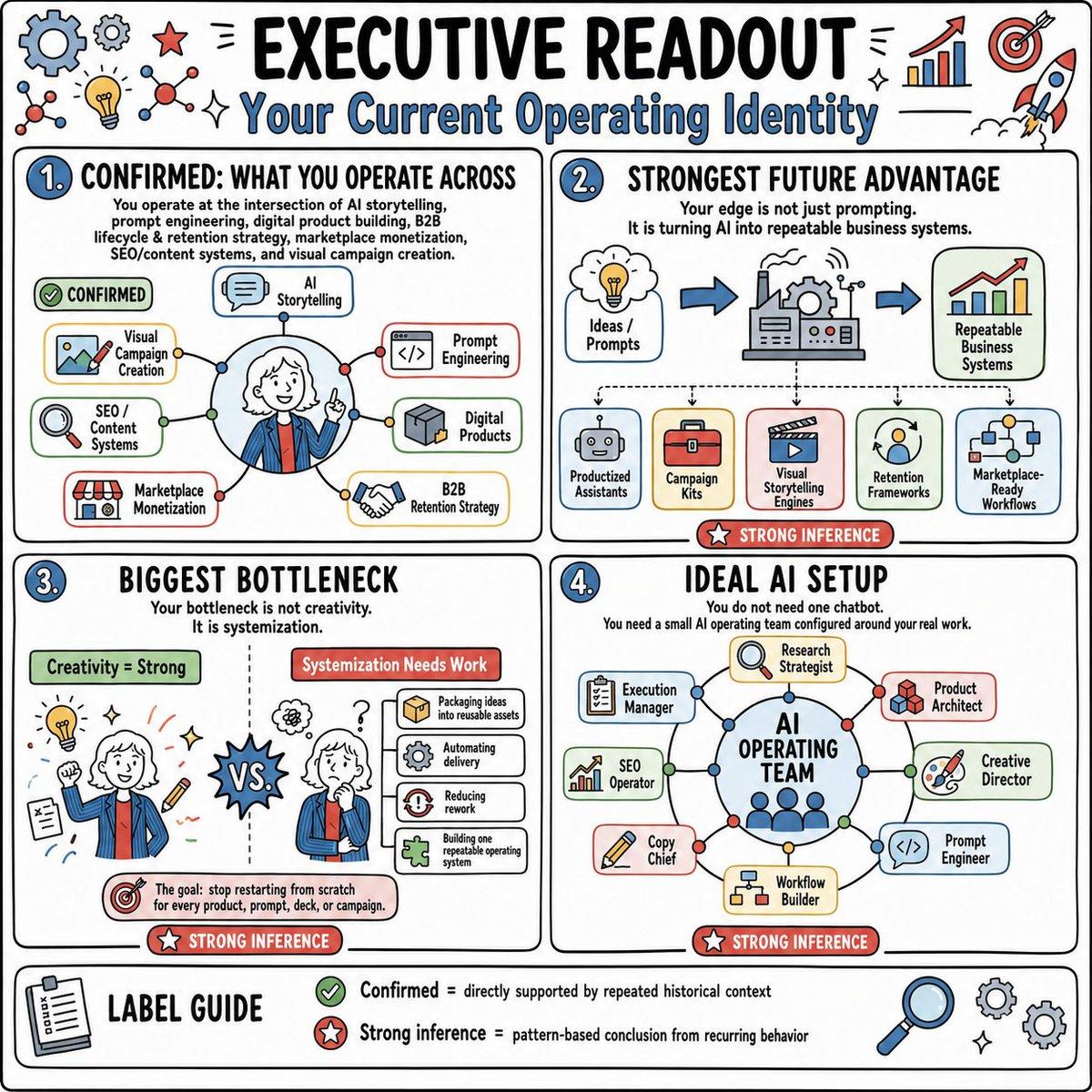
Goal: Create a hand-drawn strategy infographic titled {argument name="headline text" default="EXECUTIVE READOUT"} with the subtitle {argument name="subtitle text" default="Your Current Operating Identity"}, summarizing an AI/business operating identity in a playful consulting whiteboard style. Canvas: Square 1:1 image, white background, thick black rounded outer border, black hand-lettered typography with blue accents, red inference badges, green confirmation badges, and small doodle icons around the margins. Use a clean sketchnote style with marker-like outlines, subtle off-white card fills, and lightly colored icon panels. Layout: Divide the page into four large rounded rectangular panels in a 2-by-2 grid, plus one full-width label guide strip at the bottom. Each main panel has a blue numbered circle at top left. Add decorative icons around the top edge: exactly 11 visible doodles/icons consisting of a large blue gear, a small gray gear, a red star, two molecule/network icons, a yellow lightbulb, two sparkle marks, a rising bar chart with red arrow, a red target with arrow, and a rocket. Panel 1: Numbered “1.” and titled “CONFIRMED: WHAT YOU OPERATE ACROSS.” Add the explanatory text: “You operate at the intersection of AI storytelling, prompt engineering, digital product building, B2B lifecycle & retention strategy, marketplace monetization, SEO/content systems, and visual campaign creation.” Show a central circular portrait of a smiling professional with white hair wearing a blue jacket and red tie, pointing upward, surrounded by connected nodes. Include exactly 7 labeled capability boxes around the portrait: “AI Storytelling,” “Prompt Engineering,” “Digital Products,” “B2B Retention Strategy,” “Marketplace Monetization,” “SEO / Content Systems,” and “Visual Campaign Creation.” Add a green pill label reading “CONFIRMED.” Panel 2: Numbered “2.” and titled “STRONGEST FUTURE ADVANTAGE.” Add the text: “Your edge is not just prompting. It is turning AI into repeatable business systems.” Show a left-to-right flow with three large elements: a thought cloud labeled “Ideas / Prompts,” a central factory/machine with gears, and a chart card labeled “Repeatable Business Systems,” connected by blue arrows. Below it show exactly 5 output cards labeled “Productized Assistants,” “Campaign Kits,” “Visual Storytelling Engines,” “Retention Frameworks,” and “Marketplace-Ready Workflows.” Add a red badge at the bottom reading “STRONG INFERENCE.” Panel 3: Numbered “3.” and titled “BIGGEST BOTTLENECK.” Add the text: “Your bottleneck is not creativity. It is systemization.” Split the panel with a dotted vertical divider. Left side has a green header “Creativity = Strong” and shows the same person from behind amid idea doodles such as a lightbulb, pencil, notes, sparkles, and a target. Right side has a red header “Systemization Needs Work” and shows the person looking stressed with question marks and a stack of process cards. Include exactly 4 process cards: “Packaging ideas into reusable assets,” “Automating delivery,” “Reducing rework,” and “Building one repeatable operating system.” Put a spiky “VS.” burst in the center. Bottom callout with target icon: “The goal: stop restarting from scratch for every product, prompt, deck, or campaign.” Add a red badge “STRONG INFERENCE.” Panel 4: Numbered “4.” and titled “IDEAL AI SETUP.” Add the text: “You do not need one chatbot. You need a small AI operating team configured around your real work.” Show a central blue circle labeled {argument name="central system name" default="AI OPERATING TEAM"} with small person dots inside, connected to exactly 8 role cards arranged around it: “Execution Manager,” “Research Strategist,” “Product Architect,” “Creative Director,” “Prompt Engineer,” “Workflow Builder,” “Copy Chief,” and “SEO Operator.” Use thin connector lines with colored nodes. Add a red badge “STRONG INFERENCE.” Bottom label guide: Full-width rounded strip titled “LABEL GUIDE” with a clipboard icon on the left. Include exactly 2 legend entries: green check icon with “Confirmed = directly supported by repeated historical context” and red star icon with “Strong inference = pattern-based conclusion from recurring behavior.” Add three decorative icons at the right: a magnifying glass and two gears, plus tiny sparkles. Visual style: playful executive whiteboard infographic, thick black marker outlines, rounded cards, bright but restrained palette of sky blue, red, green, yellow, and gray, hand-drawn business icons, dense but readable composition, no photorealism, no shadows beyond simple marker shading. Constraints: Keep all text in English, preserve the exact four-panel structure, use exactly 4 main panels and exactly 7 capability boxes, 5 output cards, 4 process cards, 8 AI role cards, and 2 legend entries. Avoid extra sections, watermarks, logos, or unrelated text.
Choose the primary action to open PicX Studio with the available template settings. Review the model and format, personalize the creative direction, and generate when ready.
Yes. You can change the subject, setting, lighting, mood, format, and available model controls before creating your image.
This template is free to open and customize. Generation usage is shown in PicX Studio before you create.
Start with GPT Image 2, which is the model associated with this template. You can compare another compatible model for a different finish.
© 2026 PicX Studio. All rights reserved.

Follow a topic to a crawlable collection of related PicX Studio templates.
43,474 public templates available. Verified via the PicX Studio public templates API; refreshed hourly.








![Executive Corporate Editorial Portrait — A high-fidelity, corporate editorial portrait of {argument name="subject name" default="[NAME]"} with long wavy hair sw](https://cms-assets.youmind.com/media/1785223092665_zcd5pl_HOQFCANXwAACJ8--300x537.jpg)













![Minimalist Flat Vector Travel Poster — Premium minimalist flat-vector travel poster for {argument name="city name" default="[CITY_NAME]"}, 3:4 vertical format.](https://cms-assets.youmind.com/media/1787917359711_3ug846_HQX205cbMAA6F6S-300x400.jpg)

























![Cinematic Neon Rain Portrait Prompt — Subject & Pose
Reference: [Use Uploaded Face Reference]
Action: Standing with one hand casually in a pocket.
Pose: Body sl](https://pbs.twimg.com/media/G_HE2pmWcAAHsat.jpg)