How do I use the Paris Nocturnal Urban Archive Map template?
Choose the primary action to open PicX Studio with the available template settings. Review the model and format, personalize the creative direction, and generate when ready.
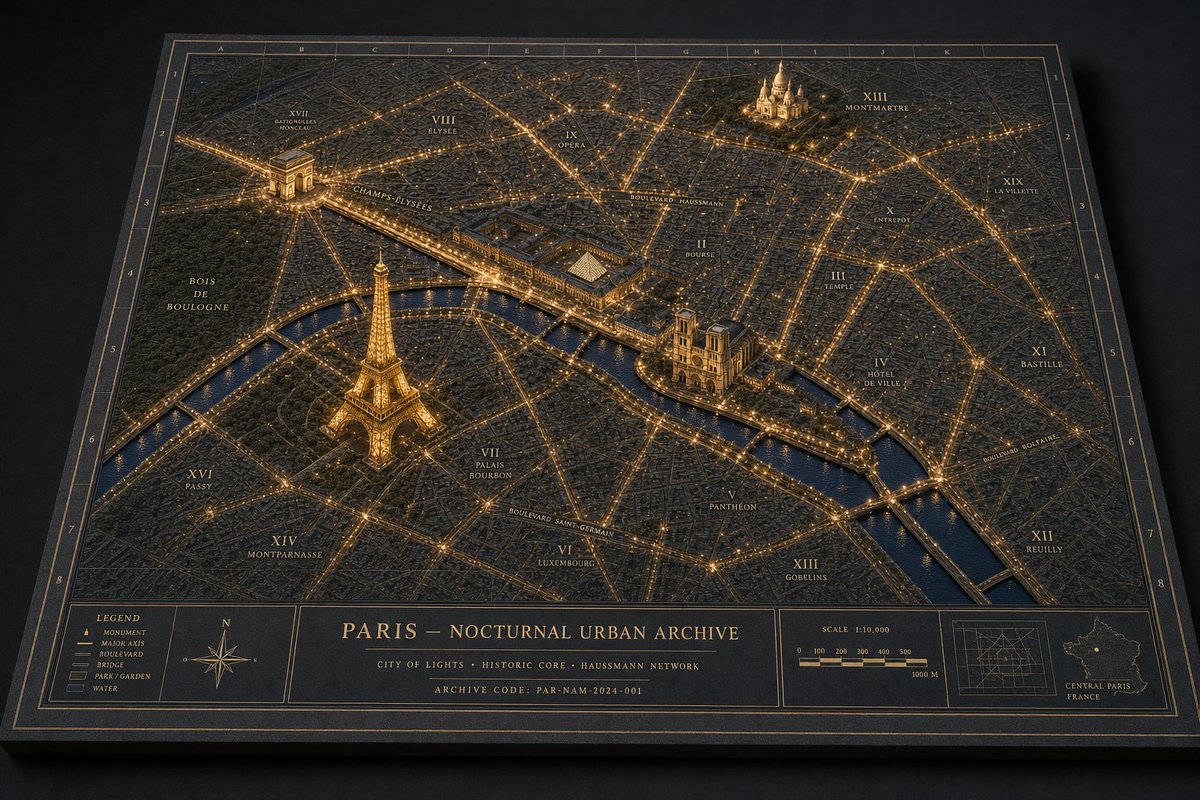
Generates a cinematic physical diorama-style night map of Paris with raised landmarks, glowing boulevards, archival labels, and museum cartography details. Change the subject, setting, or lighting one variable at a time.
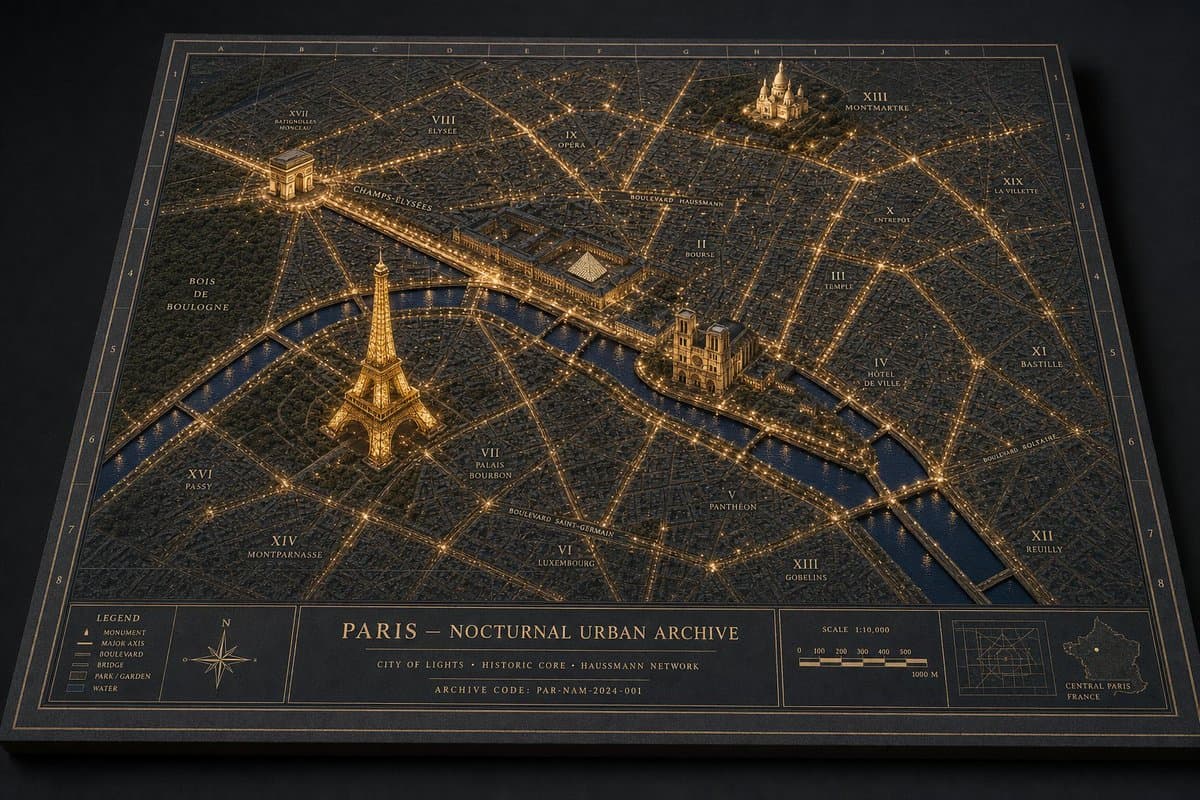
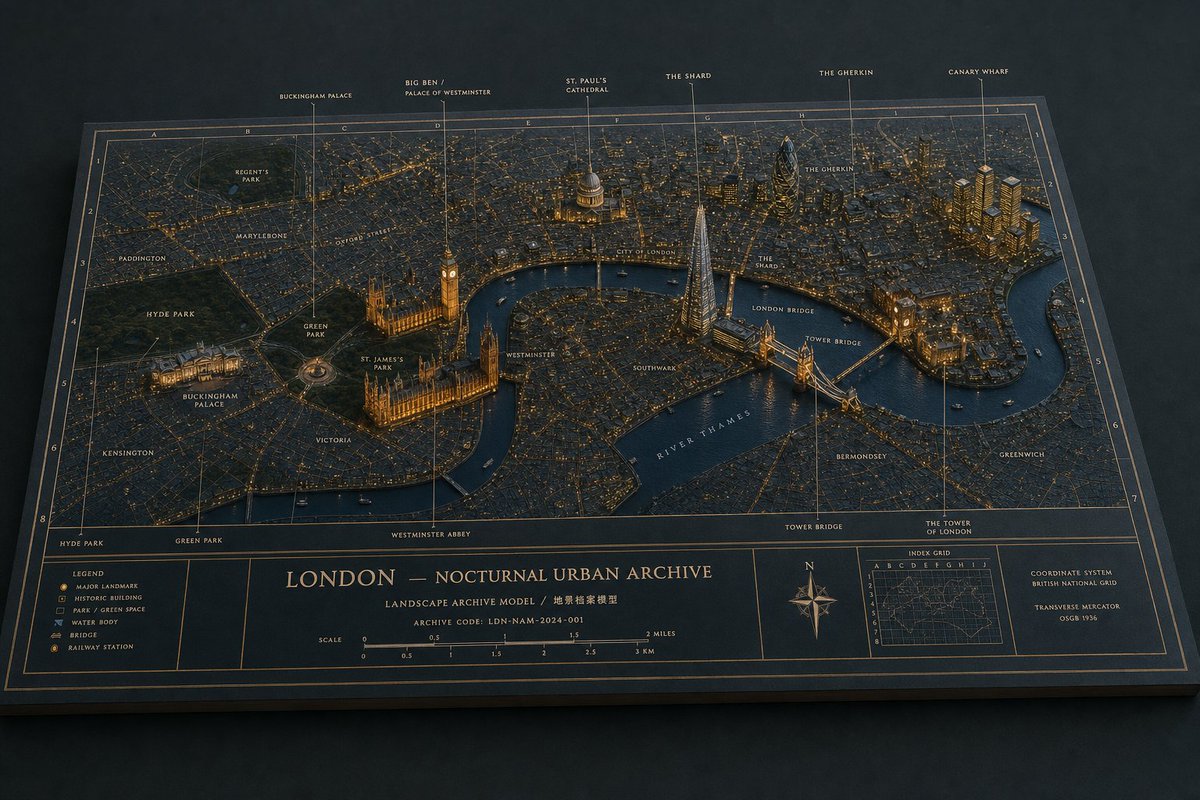
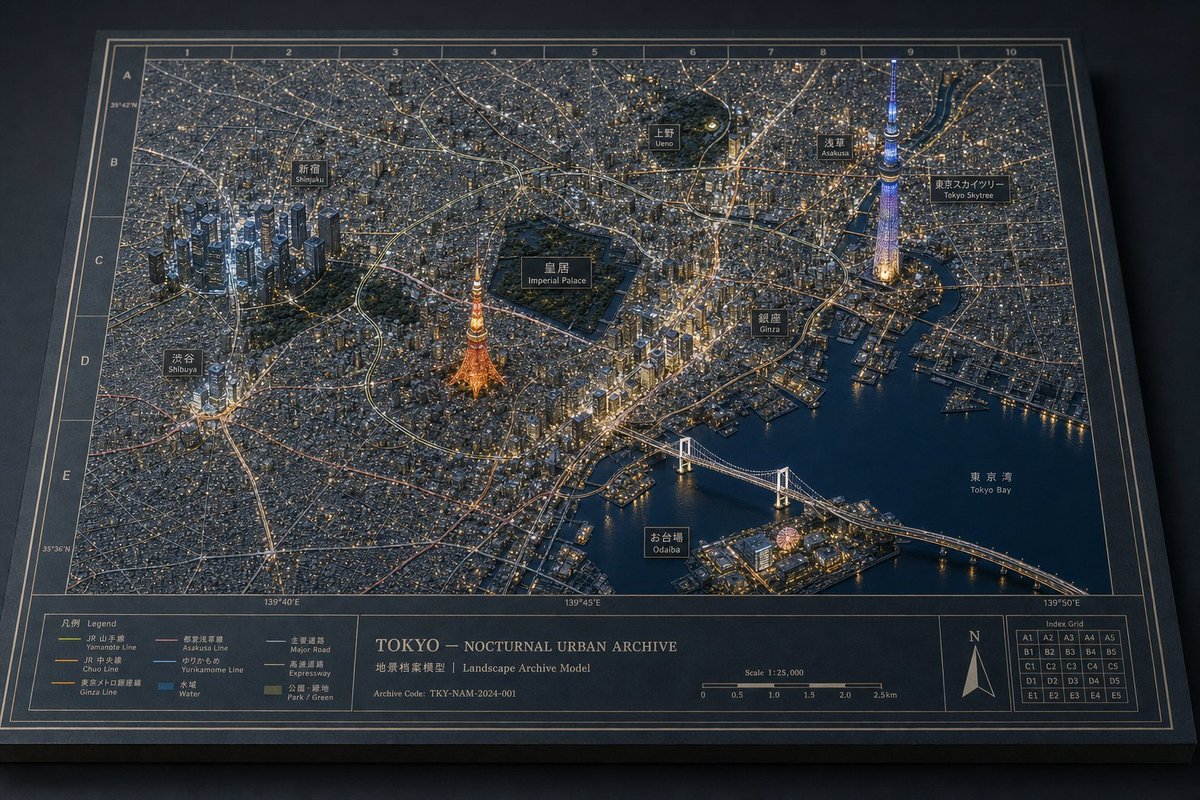
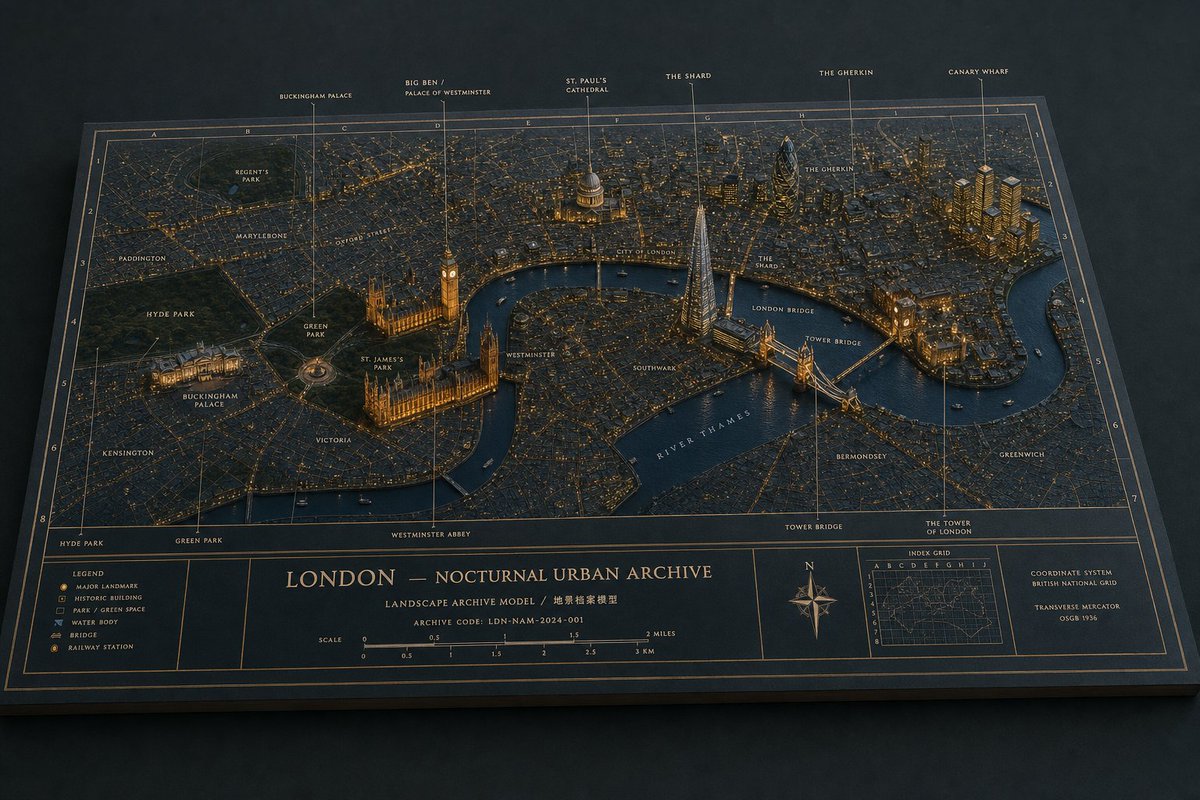
Goal: Create a museum-quality physical diorama map titled {argument name="map title" default="PARIS — NOCTURNAL URBAN ARCHIVE"}, showing {argument name="city" default="Paris"} at night as an archival landscape model with glowing streets, raised landmarks, annotation labels, and a refined cartographic border. Canvas: Landscape 3:2 perspective view of a thick rectangular archive board resting on a dark matte tabletop. Camera is angled from above, slightly front-facing, so the board has visible thickness and cast shadows. Use a dark navy, charcoal, and antique-gold palette with restrained warm amber lighting. Layout: The main map fills most of the board, surrounded by a double-line gold border and an alphanumeric coordinate grid. Use letters A–K across the top edge and numbers 1–8 down the side edges. At the bottom, include a structured information band split into 5 visible panels: 1) a legend panel, 2) a compass rose panel, 3) a large centered title/archive text panel, 4) a scale bar panel, and 5) a locator-map panel. Subject details: Render the city as a dense low-relief 3D urban model with thousands of tiny matte buildings, engraved street blocks, and a dark blue river cutting horizontally through the lower-middle area. Major boulevards and bridges glow as fine amber light lines, creating a precise nighttime network. The water should be satin navy with subtle reflections. Parks should appear as darker textured green-black areas. Raised landmarks: Include exactly 4 prominent illuminated miniature landmarks, each larger and more sculptural than the surrounding buildings: 1) the Eiffel Tower in the lower-left/left-center area near the river, glowing gold; 2) the Arc de Triomphe in the upper-left area with bright radial avenues; 3) Notre-Dame Cathedral on the island near the center-right river bend; 4) Sacré-Cœur on the upper-right hill area. Keep the landmarks physically plausible, matte, finely detailed, and warmly lit. Map labels and annotations: Add fine serif gold typography directly on the map, like an architectural archive plate. Include exactly 14 visible district/area labels: XVII Batignolles Monceau, VIII Élysée, IX Opéra, XIII Montmartre, XIX La Villette, X Entrepôt, II Bourse, III Temple, IV Hôtel de Ville, XI Bastille, XII Reuilly, XIII Gobelins, VI Luxembourg, XIV Montparnasse. Add major route labels including Champs-Élysées, Boulevard Haussmann, Boulevard Saint-Germain, and Boulevard Bessières. Labels should be legible but small, integrated into the model. Bottom information band text: In the center title panel, show the title {argument name="map title" default="PARIS — NOCTURNAL URBAN ARCHIVE"}. Under it, add the subtitle {argument name="subtitle" default="CITY OF LIGHTS · HISTORIC CORE · HAUSSMANN NETWORK"}. Add a final small line: {argument name="archive code" default="ARCHIVE CODE: PAR-NAM-2024-001"}. In the legend panel, list exactly 5 items with small symbols: Monument, Major Axis, Boulevard, Bridge, Park / Garden, Water. In the scale panel, show “SCALE 1:10,000” with a segmented bar labeled 0, 100, 200, 300, 400, 500, and 1000 M. In the locator panel, include a small grid diagram and a tiny outline map labeled “CENTRAL PARIS FRANCE.” Visual style: Hyper-realistic macro photography of a handcrafted architectural archive model; matte black paper, engraved gold ink, miniature plaster or resin buildings, warm pinprick LED-like city lights, shallow depth of field, crisp central details, soft vignette, realistic paper grain, tactile board edges, subtle dust and material texture. The image should feel like a physical museum diorama photographed in low light, not a flat digital map. Constraints: Keep the palette dark and elegant; no people, cars, modern UI, bright neon, or glossy plastic. Preserve the single-board archival presentation and the exact 4 raised landmarks, 5 bottom panels, 5 legend items, and 14 district/area labels.
Choose the primary action to open PicX Studio with the available template settings. Review the model and format, personalize the creative direction, and generate when ready.
Yes. You can change the subject, setting, lighting, mood, format, and available model controls before creating your image.
This template is free to open and customize. Generation usage is shown in PicX Studio before you create.
Start with GPT Image 2, which is the model associated with this template. You can compare another compatible model for a different finish.
© 2026 PicX Studio. All rights reserved.

Follow a topic to a crawlable collection of related PicX Studio templates.
43,474 public templates available. Verified via the PicX Studio public templates API; refreshed hourly.






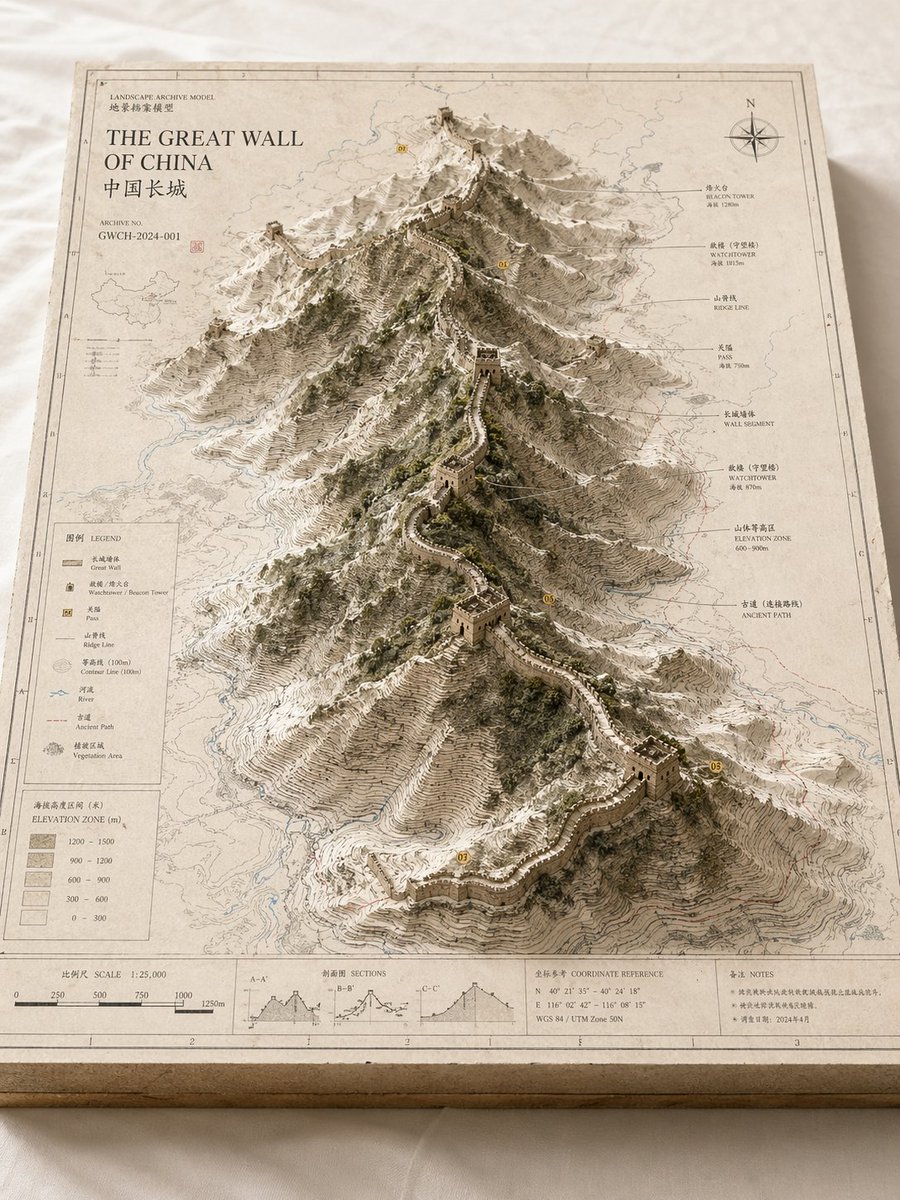


![Minimalist Flat Vector Travel Poster — Premium minimalist flat-vector travel poster for {argument name="city name" default="[CITY_NAME]"}, 3:4 vertical format.](https://cms-assets.youmind.com/media/1787917359711_3ug846_HQX205cbMAA6F6S-300x400.jpg)















![Two-Step Tier List Generation Prompt — Make a json of a tier list (S-F scale) for: {argument name="category" default="[*insert-here*]"}
Now generate image with](https://pbs.twimg.com/media/G7qb77fXEAEYJwB.jpg)