How do I use the Tokyo Nocturnal Urban Archive template?
Choose the primary action to open PicX Studio with the available template settings. Review the model and format, personalize the creative direction, and generate when ready.
A structured prompt for generating a photorealistic nighttime Tokyo architectural archive diorama with labeled landmarks, map legend, scale bar, and index grid. Change the subject, setting, or lighting one variable at a time.
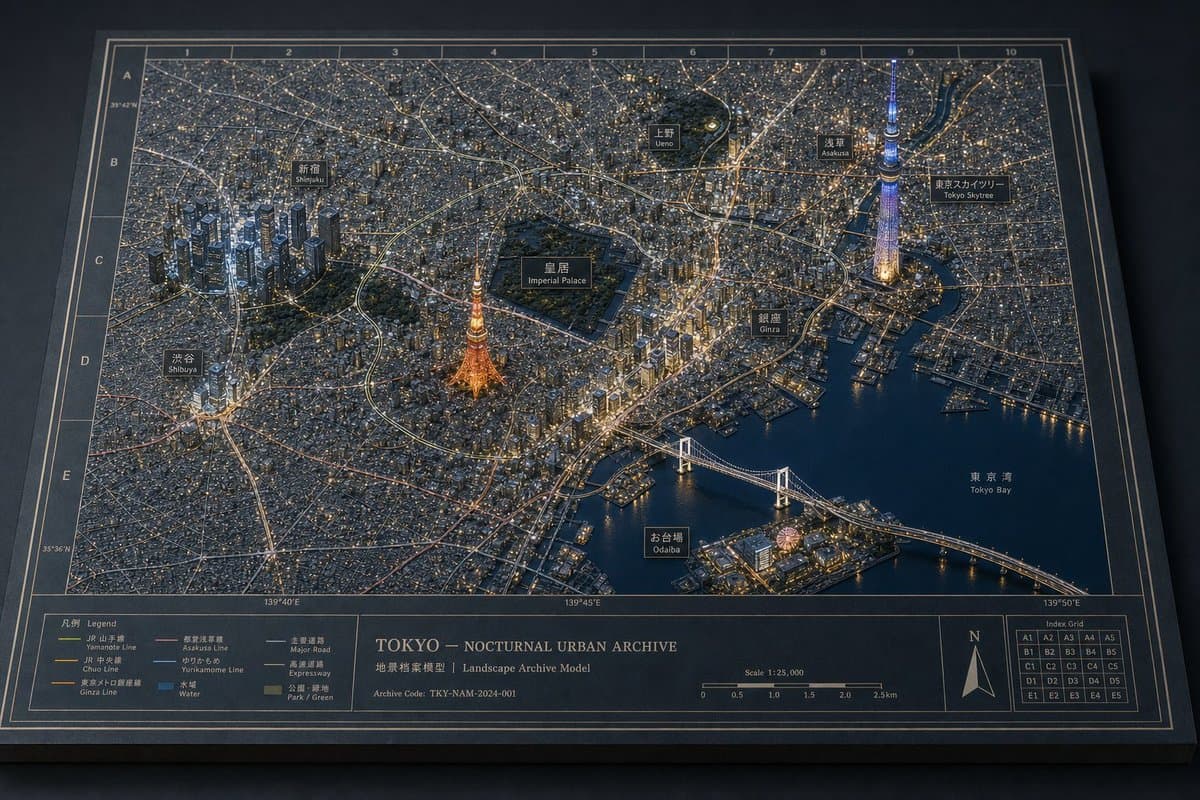
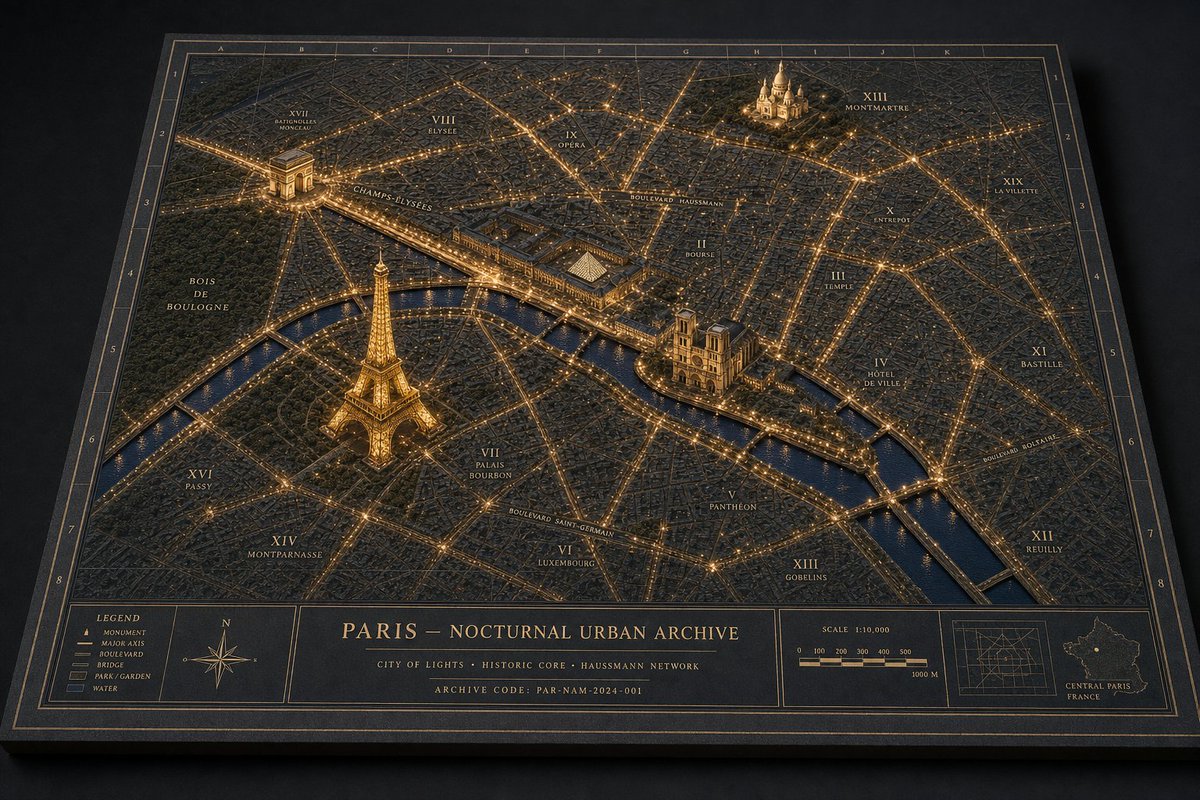
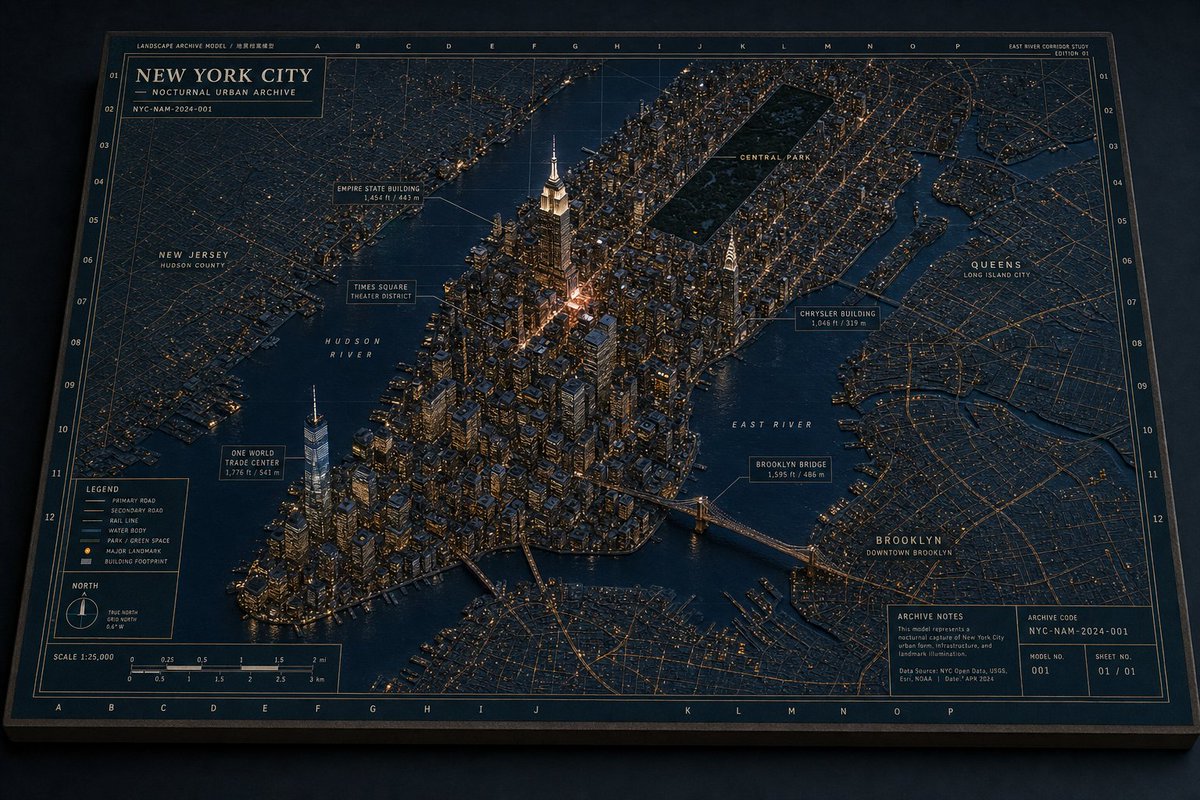
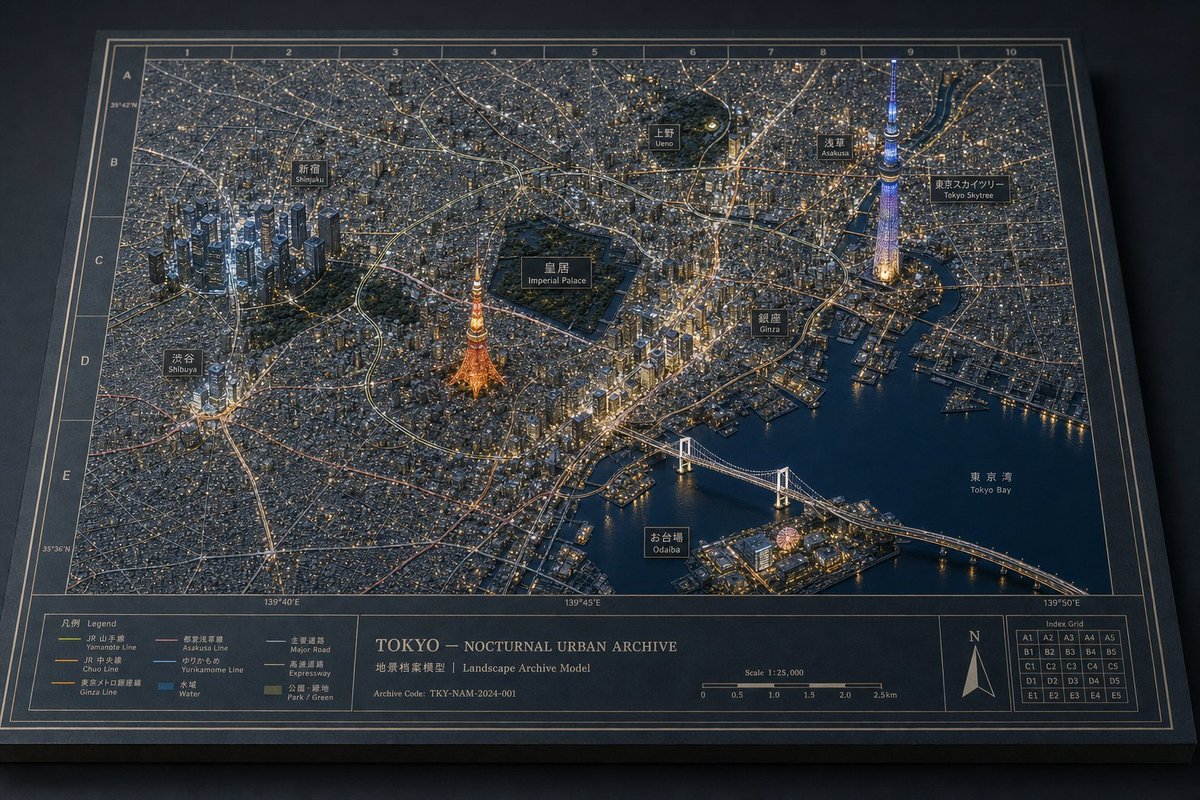
Goal: Create a highly realistic physical museum-diorama style city map titled {argument name="archive title" default="TOKYO — NOCTURNAL URBAN ARCHIVE"}, showing Tokyo at night as a layered architectural archive model on a dark tabletop. Canvas: Wide landscape image, 3:2 aspect ratio, viewed from an elevated oblique angle. The entire scene is a rectangular black archival board with a thin cream double-line border, coordinate grid, index markings, and printed cartographic annotations. Use a restrained night palette: charcoal paper, navy water, warm amber city lights, cool white road lines, and selective blue/purple tower lighting. Layout: The main map occupies the upper 80% of the board and shows an ultra-dense 3D miniature urban model with thousands of low-rise buildings, raised clusters of skyscrapers, glowing roads, rail lines, bridges, waterways, parks, and harbor piers. The bottom 20% is a printed archive information strip containing a legend on the left, the title block in the center, a scale bar, a north arrow, and an index grid on the right. Add realistic paper grain, matte model surfaces, tiny cast shadows, engraved-looking map lines, and soft studio lighting from above. City content: Depict {argument name="city name" default="Tokyo"} as a nocturnal urban archive. Include exactly 9 labeled landmark callout plaques on the map, each black with thin cream borders and bilingual Japanese/English styling: 1) Shinjuku, 2) Shibuya, 3) Imperial Palace, 4) Ueno, 5) Asakusa, 6) Tokyo Skytree, 7) Ginza, 8) Odaiba, 9) Tokyo Bay. Place Shinjuku as a dense blue-lit skyscraper cluster on the left, Shibuya lower-left, the dark green Imperial Palace park in the center, Tokyo Tower glowing orange near the center-lower area, Tokyo Skytree glowing blue-purple on the right, Ginza near the waterfront, Odaiba on an island near the bottom, and Tokyo Bay as dark navy water on the right. Map details: Add a coordinate frame with columns numbered 1 through 10 across the top and rows labeled A through E down the left edge. Include latitude/longitude markings around the border. Show a dense street network as fine pale lines, major expressways as brighter sweeping curves, rail lines as subtly colored routes, and water areas as smooth dark navy shapes. Include a prominent illuminated suspension bridge across Tokyo Bay in the lower-right quadrant. Bottom archive strip: Include exactly 1 legend box on the bottom-left with the heading “Legend” and 8 line/style entries: 1) Yamanote Line, 2) JR / Chuo Line, 3) Ginza Line, 4) Asakusa Line, 5) Yurikamome Line, 6) Water, 7) Major Road, 8) Park / Green. In the center title block, print “TOKYO — NOCTURNAL URBAN ARCHIVE”, a smaller subtitle “Landscape Archive Model”, and an archive code {argument name="archive code" default="TKY-NAM-2024-001"}. Include exactly 1 scale bar labeled “Scale 1:25,000” with tick labels from 0 to 2.5 km. Include exactly 1 north arrow and exactly 1 index grid at the far right with 25 cells labeled A1 through E5. Visual style: Photorealistic macro photography of a handcrafted physical cartographic diorama, like an architectural museum model photographed in a dark studio. Use crisp micro-detail, shallow-but-readable depth of field, realistic shadows under elevated buildings, reflective water, warm window glows, and subtle paper texture. No people, no cars large enough to dominate, no extra landmarks beyond the specified labels, no watermark.
Choose the primary action to open PicX Studio with the available template settings. Review the model and format, personalize the creative direction, and generate when ready.
Yes. You can change the subject, setting, lighting, mood, format, and available model controls before creating your image.
This template is free to open and customize. Generation usage is shown in PicX Studio before you create.
Start with GPT Image 2, which is the model associated with this template. You can compare another compatible model for a different finish.
© 2026 PicX Studio. All rights reserved.

Follow a topic to a crawlable collection of related PicX Studio templates.
43,474 public templates available. Verified via the PicX Studio public templates API; refreshed hourly.












![Minimalist Flat Vector Travel Poster — Premium minimalist flat-vector travel poster for {argument name="city name" default="[CITY_NAME]"}, 3:4 vertical format.](https://cms-assets.youmind.com/media/1787917359711_3ug846_HQX205cbMAA6F6S-300x400.jpg)