How do I use the Toy Ferrari Storyboard Contact Sheet template?
Choose the primary action to open PicX Studio with the available template settings. Review the model and format, personalize the creative direction, and generate when ready.
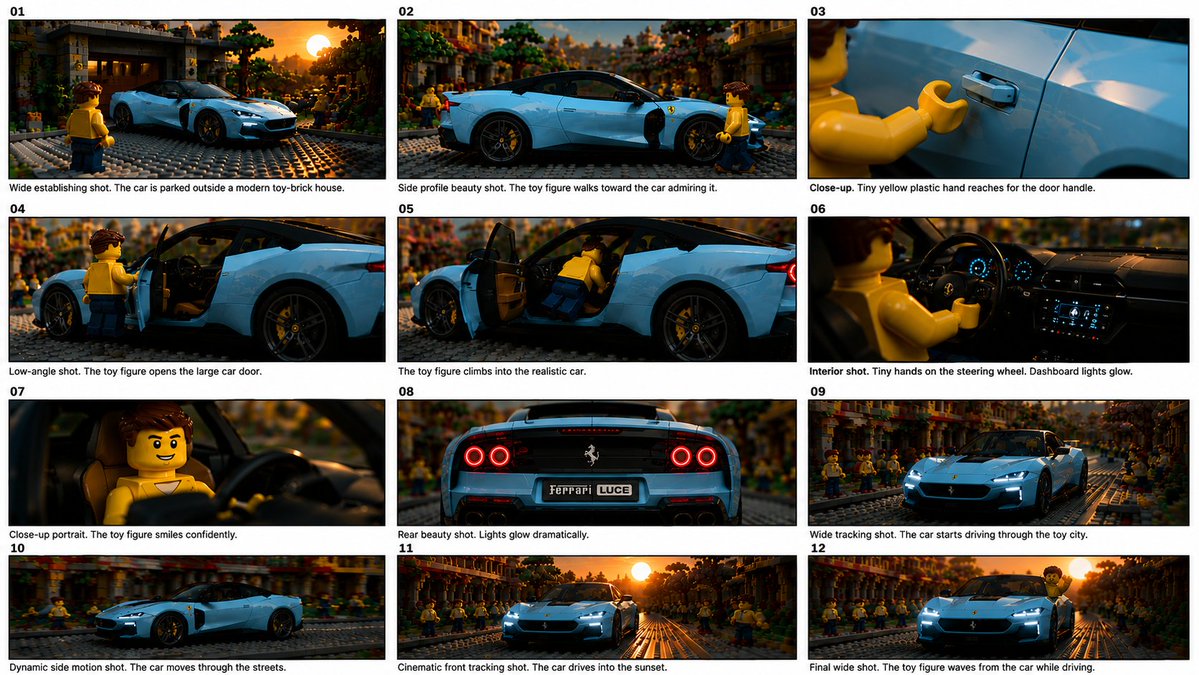
A structured prompt for generating a 12-panel cinematic storyboard of a LEGO-style minifigure driving a realistic blue Ferrari through a miniature city. (free to use) — Free AI image template on PicX Studio.
Goal: Create a cinematic 12-panel storyboard contact sheet showing a toy-like LEGO-style yellow minifigure discovering, entering, and driving a realistic light-blue Ferrari sports car through a miniature brick city at sunset. Canvas: Wide horizontal storyboard sheet, approximately 16:9, with a clean white background, thin black panel borders, and exactly 12 numbered still frames arranged in a 3-column by 4-row grid. Each panel has a bold two-digit number in the top-left corner from 01 to 12 and a short black caption underneath in small documentary storyboard text. Visual style: Hyper-realistic macro toy photography mixed with cinematic automotive advertising. Use shallow depth of field, warm golden-hour sunset lighting, glossy reflections, dramatic lens flare, detailed brick road texture, miniature city buildings, and a crowd of yellow toy minifigures in the background. The car should look like a full-detail real exotic coupe, not a toy, with black wheels, low body, LED headlights, and premium interior. The main figure is a classic yellow plastic toy person with brown molded hair, simple smiling face, yellow torso, blue legs, and claw-shaped hands. Overall mood is playful, premium, and cinematic. Subject details: The hero car is a {argument name="car description" default="light-blue Ferrari-style supercar coupe"}. The main toy driver is a {argument name="character description" default="yellow LEGO-style male minifigure with brown hair, yellow shirt, blue pants, and claw hands"}. The setting is a {argument name="setting" default="miniature brick-built city street at sunset"}. Use warm orange sunlight from the horizon, realistic reflections on the blue paint, and many background toy figures watching. Storyboard panels: Include exactly 12 discrete panels with these shots and captions: 01. Wide establishing shot. The car is parked outside a modern toy-brick house. 02. Side profile beauty shot. The toy figure walks toward the car admiring it. 03. Close-up. Tiny yellow plastic hand reaches for the door handle. 04. Low-angle shot. The toy figure opens the large car door. 05. The toy figure climbs into the realistic car. 06. Interior shot. Tiny hands on the steering wheel. Dashboard lights glow. 07. Close-up portrait. The toy figure smiles confidently. 08. Rear beauty shot. Lights glow dramatically. Add a readable license plate that says {argument name="license plate text" default="Ferrari LUCE"}. 09. Wide tracking shot. The car starts driving through the toy city. 10. Dynamic side motion shot. The car moves through the streets. 11. Cinematic front tracking shot. The car drives into the sunset. 12. Final wide shot. The toy figure waves from the car while driving. Text and numbering: Use clear black frame numbers 01, 02, 03, 04, 05, 06, 07, 08, 09, 10, 11, and 12. Place each caption below its matching panel in English. Keep typography simple and legible, like a printed storyboard proof sheet. Constraints: Exactly 12 panels, exactly 3 columns and 4 rows, no extra panels, no missing captions, no watermark. Maintain continuity of the same blue car, same toy figure, same miniature city, and same sunset lighting across all frames. Make the image feel like stills from a polished miniature car commercial titled {argument name="commercial mood" default="playful luxury toy-car adventure"}.
Use Toy Ferrari Storyboard Contact Sheet to plan an AI image around gpt-image-2 generation, themes such as en and gpt-image-2. Match the preview's composition first, then personalize the subject, setting, and mood for your own project.
Use the primary action to load the template settings in PicX Studio.
Adjust the subject and creative details for your destination.
Create the image, compare the result with the preview, and refine one variable at a time.
A continuous mix — similar concepts first, woven with same-model prompts and fresh picks from the catalog.
Choose the primary action to open PicX Studio with the available template settings. Review the model and format, personalize the creative direction, and generate when ready.
Yes. You can change the subject, setting, lighting, mood, format, and available model controls before creating your image.
This template is free to open and customize. Generation usage is shown in PicX Studio before you create.
Start with gpt-image-2, which is the model associated with this template. You can compare another compatible model for a different finish.
Follow a topic to a crawlable collection of related PicX Studio templates.
39,157 public templates available. Verified via the PicX Studio public templates API; refreshed hourly.
A continuous mix — similar concepts first, woven with same-model prompts and fresh picks from the catalog.